Skip to main content

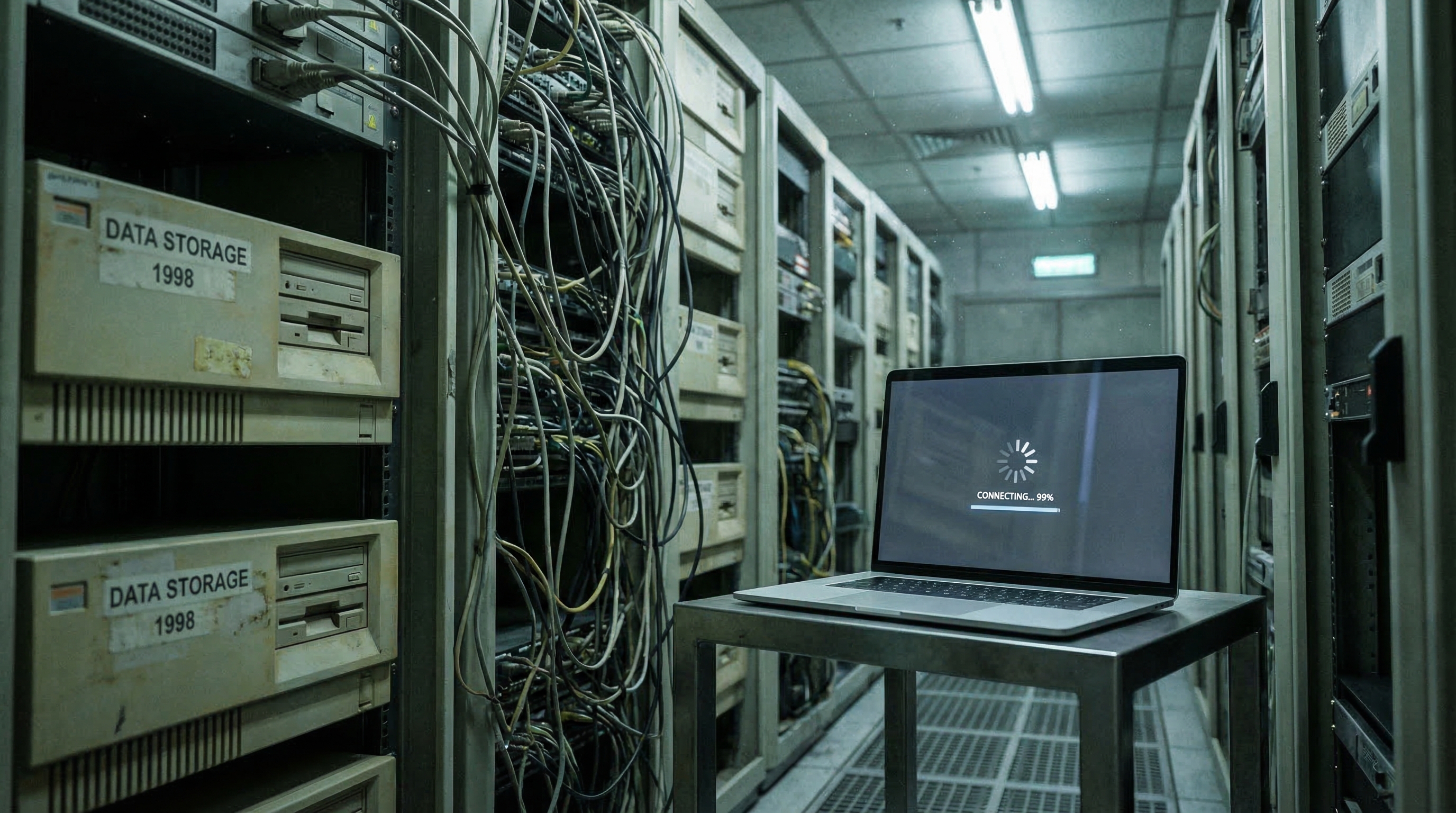
Most European companies launching an AI project today hit the same wall. It's not a technology problem. It's not a budget issue, nor a data skills gap. It's an infrastructure problem. More specifically: it's technical debt accumulated over 10, 15, sometimes 20 years, making every AI initiative structurally fragile.
52% of enterprises declare reducing technical debt a top priority in 2026. 45% target cloud optimization. But in practice, most investment goes toward maintenance and compliance rather than real transformation. Organizations patch. They don't modernize.
We see this gap in nearly every client engagement. And we believe it's the most underestimated issue of the decade.
Enterprise AI relies on three foundations: accessible data, reliable pipelines, and infrastructure capable of handling new workloads. When these foundations don't exist, the AI project doesn't collapse immediately. It produces inconsistent results, timelines stretch, costs spiral, and eventually a POC that never makes it to production.
The problem is structural. Many organizations still depend on legacy infrastructure unable to support modern workloads, and they don't even have a clear picture of what's actually deployed. No visibility into dependencies. No up-to-date documentation. Systems interconnected through integrations cobbled together a decade ago that nobody fully understands anymore.
In that context, deploying a machine learning model is like adding another floor to a building where nobody has checked the foundations.
Before discussing algorithms or models, three questions deserve an honest answer.
1. Where is your data, and what state is it in? Not "what data do you have" but "where does it physically live, who accesses it, what formats, what duplicates, what inconsistencies between systems." At one of our institutional clients, we identified 14 distinct data sources for a single business metric. 14 versions of the truth. No AI model can produce reliable output under those conditions.
2. Can your infrastructure handle variable workloads? An AI model in production doesn't consume resources linearly. There are compute spikes, high memory demands, training phases that saturate resources for hours. If your infrastructure already runs at 80% capacity for day-to-day operations, there's no room for AI.
3. How many critical systems rely on code that nobody actively maintains? This is the question nobody asks in the boardroom. Yet it's often the one that determines whether an AI project will work or not. A COBOL mainframe running billing since 1998, a proprietary middleware whose vendor has been acquired three times, a database last updated in 2019. These systems aren't technical footnotes. They're business risks.
European companies still running COBOL mainframes pay between $1,000 and $2,000 per MIPS annually. That's a massive operating cost for systems that, by definition, will never support modern AI workloads.
The cost of not modernizing goes beyond the hosting bill. It includes opportunity cost: every month spent maintaining a legacy system is a month behind a competitor who has already migrated and can deploy AI on clean infrastructure.
Cloud migration projects show returns on investment reaching up to 362%. That number isn't theoretical. It reflects the combination of reduced operating costs, the ability to scale, and the possibility of deploying modern services (including AI) without a full rebuild.
This is the most interesting twist. AI isn't just the destination of modernization. It's also the tool.
AI-assisted application modernization now makes transformations economically feasible that were unrealistic five years ago. Legacy language translation (COBOL to Java, for instance), assisted re-platforming, automated dependency detection in undocumented code, progressive re-architecture guided by traffic flow analysis.
In practice, this means a company no longer has to choose between "keep everything" and "rebuild everything." A modular approach, AI-assisted, allows modernization component by component, starting with the systems that block the most business value.
We apply this logic with our clients: identify the 3 to 5 systems where technical debt has the highest business impact, then modernize them in an order that progressively unlocks the capacity to deploy AI. It's a virtuous cycle: each modernized component makes the next one simpler to address.
Short answer: incremental, always.
Big bang migrations have a documented failure rate that should convince any CTO. The strangler fig approach, which consists of progressively encapsulating legacy systems within modern layers, remains the most reliable method for complex environments.
The important nuance: "incremental" does not mean "without an overall vision." Each step must fit within a target architecture defined upfront. The difference between a successful modernization and yet another layer of patches is the quality of the initial audit and the clarity of the target state.
Three concrete actions, in this order.
Map what you have. Not a standard IT inventory. A mapping that links every system to its business function, its level of technical debt, and its ability to support AI workloads. The goal is to know exactly where the organization stands, with no blind spots.
Prioritize by business impact. Not all legacy systems are equal. Some are stable and non-critical. Others directly block the company's ability to deliver value. Those are where modernization efforts should focus first.
Use AI as a modernization accelerator, not as the end goal. The classic trap: setting "deploy AI" as a strategic objective without ensuring the infrastructure can keep up. The reverse approach works better: use AI to modernize, then deploy AI on the modernized infrastructure.
The conversation about enterprise AI is biased. It almost always starts with use cases, models, promised productivity gains. It should start with a simple question: is your infrastructure ready?
At DNA Solutions, we've been helping European organizations — institutions, enterprise clients, industrial SMEs — answer that question for over 15 years. We've modernized critical systems for the European Commission, T-Systems, Canon. Our conviction: before promising AI to the board, someone needs to have the courage to deliver an honest diagnosis of the actual state of the infrastructure.
It's less exciting than a ChatGPT prototype. It's infinitely more useful.