Skip to main content

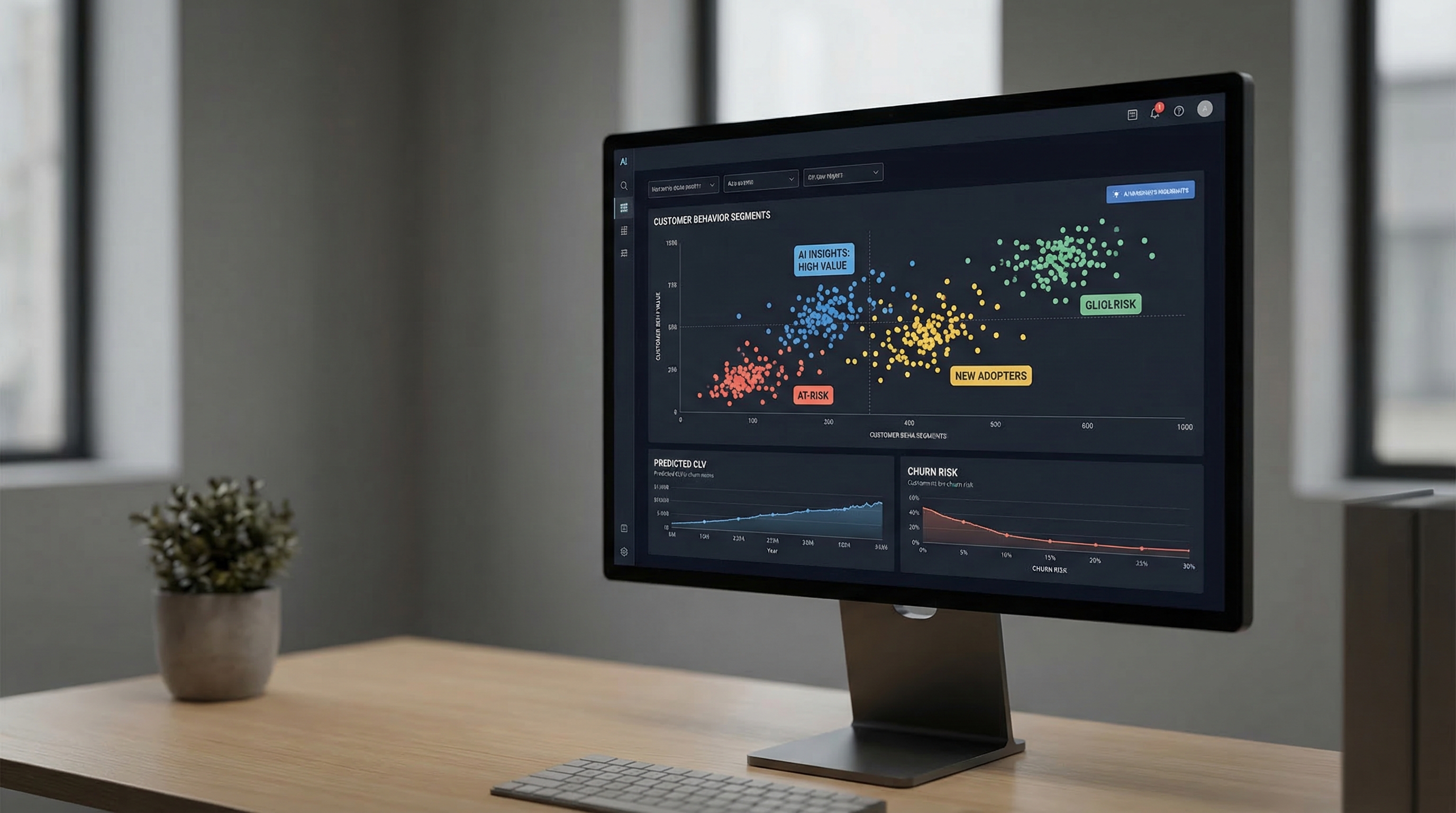
A clothing retailer we worked with had a loyalty program with 340,000 active members. Their marketing team was convinced they knew their customers well. Segments by age, purchase frequency, average basket size. Standard stuff. When we ran a behavioral clustering model on the same data, we found 14 distinct customer profiles that cut across every demographic segment they had built. Their highest-value customers weren't who they thought they were. Their churn risk model was backwards. And the campaigns they'd been running for two years were optimized for segments that didn't reflect how people actually buy.
This is not an unusual story. It's the norm.
Most retail organizations operate on a version of customer understanding that was built for a simpler world. Demographics, declared preferences, historical purchase patterns. These inputs aren't wrong. They're just incomplete in ways that lead to expensive mistakes.
AI doesn't replace marketing intuition. But it reveals patterns that human analysis physically cannot detect at scale. And in an industry where margins are thin and customer attention is fragmented, that difference is worth real money.
Traditional segmentation assumes that people who look similar behave similarly. A 35-year-old woman in Brussels with two children and a household income of €75,000 is expected to buy like other 35-year-old women in Brussels with similar profiles. The entire targeting logic follows from this assumption.
The problem is that purchasing behavior is driven by context, not demographics. The same person buys differently on a Tuesday evening after a stressful day than on a Saturday morning with family. They respond to different messages depending on whether they're browsing on their phone during a commute or sitting at home on a laptop. Their sensitivity to pricing shifts depending on the category, the season, and what competitor they last interacted with.
Demographic segments can't capture this. They create a static picture of a dynamic reality. The result is campaigns that feel generic to the customer and underperform for the business.
AI-based behavioral analysis doesn't start with who the customer is. It starts with what the customer does. Browsing patterns, purchase sequences, response to promotions, time between visits, category migration over time, sensitivity to specific triggers. From these behaviors, the model identifies clusters that share actual decision-making patterns, regardless of whether the people in those clusters share any demographic characteristics.
The output isn't "women aged 30-40 in urban areas." It's "customers who browse three times before purchasing, respond to scarcity messaging but not discounts, and tend to add a second item when free shipping is offered." That level of specificity changes everything about how you design a campaign.
Three things, consistently.
Churn signals that precede the event by weeks. By the time a traditional analysis flags a customer as "at risk" (usually based on a drop in purchase frequency), the customer has already mentally left. AI models that analyze behavioral micro-signals (changes in browsing depth, time-on-site patterns, shift in category interest, response to email opens without clicks) can identify churn risk 4 to 8 weeks earlier. That's the difference between a retention campaign that works and one that arrives too late.
Cross-category affinities that aren't obvious. A human analyst might notice that people who buy running shoes also buy sports drinks. That's intuitive. What AI detects is that customers who buy a specific type of scented candle in November have a 3.2x higher probability of purchasing premium kitchen equipment in January. There's no intuitive link. But the pattern is statistically robust, and it translates directly into targeted campaigns that a human would never have conceived.
Price sensitivity by context, not by customer. Traditional pricing analysis assigns a price sensitivity score to a customer or a segment. AI reveals that the same customer has radically different price sensitivity depending on the category, the time of day, the device they're using, and whether they arrived via search or social media. This means that a blanket 15% discount sent to your "price-sensitive segment" is leaving money on the table for half the recipients and failing to convert the other half.
The shift is fundamental. Traditional campaign design starts with a business objective ("increase sales in category X"), defines a target segment, creates a message, and pushes it out. Performance is measured after the fact.
AI-driven campaign design inverts the process. It starts with behavioral data, identifies which customers are most likely to respond to which type of message at which moment, and then designs the campaign around those patterns. The business objective is the same. The path to get there is built from customer behavior rather than marketing assumptions.
In practice, this means three changes.
Timing becomes personalized. Instead of sending a campaign to everyone on Tuesday at 10am because "open rates are highest on Tuesday mornings," the system identifies the optimal send time for each individual based on their historical engagement patterns. One customer opens emails at 7am. Another engages with push notifications at 9pm. Sending both at the same time wastes at least one opportunity.
Messaging becomes contextual. A customer who just browsed winter coats three times without purchasing doesn't need the same email as a customer who bought a winter coat last week. The first needs a nudge (maybe social proof or a limited stock alert). The second needs a cross-sell (accessories, care products). Obvious in theory, almost impossible to execute manually across a database of 100,000+ customers.
Budget allocation becomes dynamic. Instead of splitting the marketing budget by channel at the start of the quarter and adjusting at the end, AI-driven attribution models redistribute spend in near real-time based on what's actually working. If paid social is driving conversions at a lower cost than email this week, the system shifts budget accordingly. This requires clean data integration across channels, which is where most retailers hit a wall.
This is where the conversation gets honest. The AI capabilities described above aren't science fiction. The models exist. The tools are available. But they require a data foundation that most retailers don't have.
Unified customer data. If your e-commerce platform, POS system, loyalty program, email platform, and ad accounts each hold a different version of the same customer, no AI model will produce reliable results. A customer data platform (or at minimum, a clean data warehouse with identity resolution) is the prerequisite. Not the AI model. Not the campaign tool. The data layer.
Real-time event tracking. Behavioral AI needs behavioral data. That means tracking not just transactions but micro-events: page views, search queries, cart additions and abandonments, email interactions, app sessions. If your analytics setup only captures completed purchases, you're missing 95% of the behavioral signal.
Integration between systems. The AI model that identifies the optimal send time is useless if it can't trigger the email platform. The churn prediction is useless if it doesn't feed into the CRM. Most retailers operate with disconnected tools that share data through manual exports or nightly batch syncs. AI-driven marketing requires data flowing between systems in minutes, not days.
The gap between "we want to do AI-driven marketing" and "our infrastructure supports it" is where most projects stall. And it's exactly the kind of problem that needs to be solved before investing in models or tools.
Not with AI. With data.
Step one: audit the data landscape. Map every system that holds customer data. Identify overlaps, gaps, and inconsistencies. Understand which data is real-time and which is batched. This audit typically reveals that the organization has far more data than it thinks, but in far worse shape than it assumes.
Step two: build the unified layer. Before any AI initiative, consolidate customer data into a single source of truth. This doesn't mean replacing every system. It means creating an integration layer that reconciles customer identities across platforms and makes behavioral data accessible for analysis.
Step three: start with one high-impact use case. Don't try to build an AI-powered marketing machine in one go. Pick the use case with the clearest ROI (churn prediction and retention campaigns are usually the most immediate) and prove it works end to end. Then expand.
Step four: measure against the right baseline. The question isn't "did the AI campaign perform well?" It's "did it perform better than what we were doing before, and by how much?" If you can't answer that, you can't justify scaling.
Retail marketing has always been about understanding customers. The tools to do that have changed fundamentally. AI doesn't replace the marketer's judgment about brand, positioning, or creative direction. It replaces the guesswork about who to reach, when, and with what message.
The retailers who figure this out will spend less to convert more. The ones who don't will keep optimizing campaigns for segments that don't exist.
At DNA Solutions, we help retail organizations build the data infrastructure and analytical capabilities that make AI-driven marketing possible. Not the shiny prototype. The actual plumbing that turns customer data into actionable intelligence. Because the best AI model in the world is useless if it's sitting on top of broken data.