Skip to main content

Honest insights from 15 years of enterprise consulting
Meta description: Before hiring an IT modernization consultant, read this. DNA Solutions shares 5 things you can fix yourself — and where the real risks begin, especially with AI.
Reading time: 6 min
Every week, we talk to CTOs and IT directors who think they need a full-scale modernization project. Most of them don't. At least, not yet.
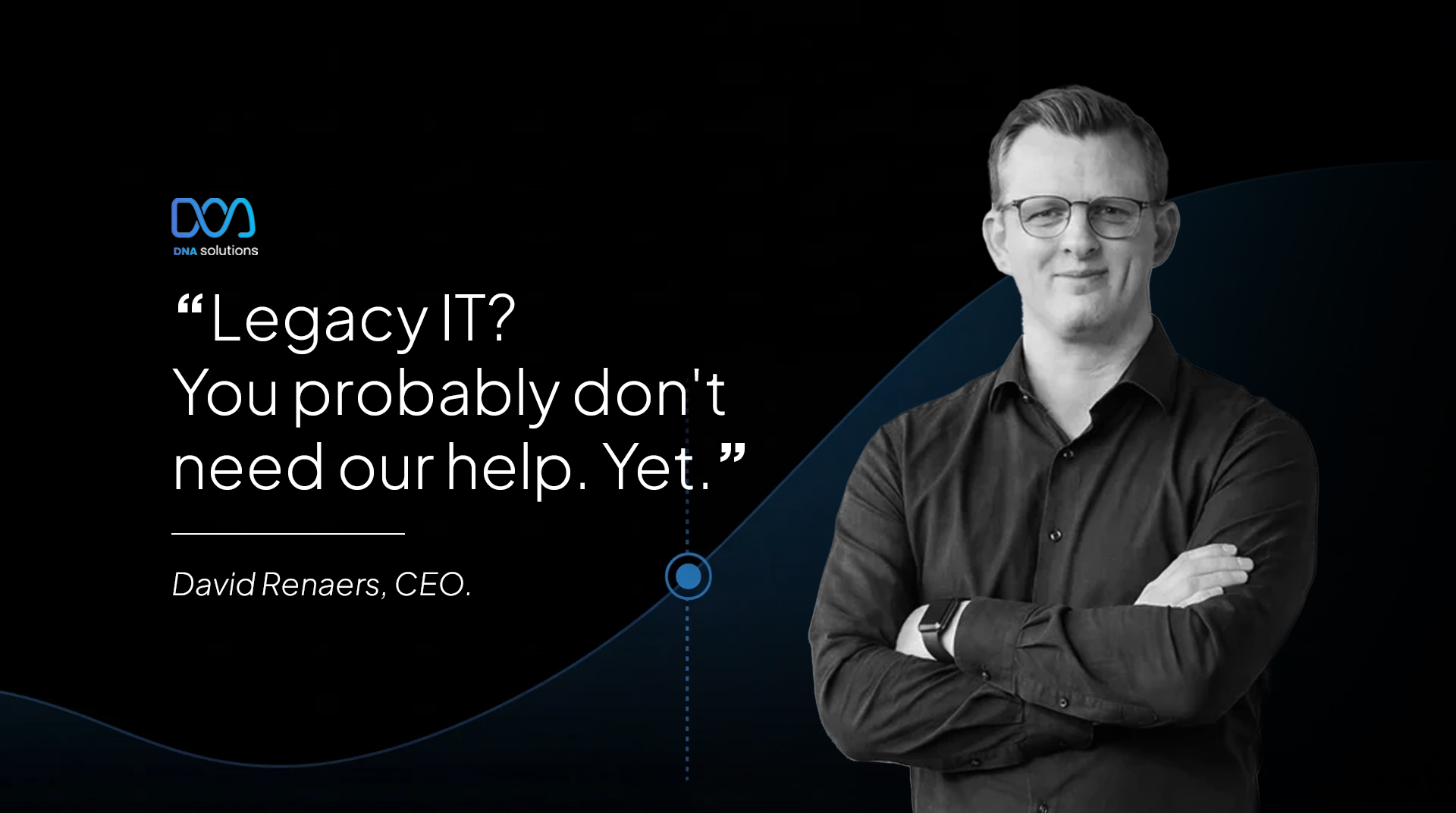
At DNA Solutions, we've spent 15 years helping enterprises modernize their legacy infrastructure. We've worked with organizations like T-Systems, Canon, and the European Commission — some of them for over six years. These partnerships didn't start because they couldn't do anything without us. They started because we told them the truth. Sometimes, that truth was: "You don't need us for this."
That's not a marketing gimmick. It's how we operate. We'd rather lose a deal than waste someone's budget.
So before you send that RFP, before you book that "discovery call" with a consultancy that's already sizing up your wallet — here are five things you can handle on your own. For free, or close to it.
This is the most overlooked step in any modernization initiative, and it costs nothing but time.
Most enterprises don't have a modernization problem. They have a visibility problem. Nobody knows exactly what's running, where it's running, and whether it still needs to be running. Over the years, systems pile up. A test server from 2017 that nobody dared to shut down. A middleware layer that was "temporary" five years ago. A database that three people swear is critical, but none of them can explain what it does.
Before spending a single euro on consultants, take stock. Map your infrastructure. Document what each system does, who owns it, and when it was last updated. You'll be surprised how many "critical" legacy systems turn out to be digital ghosts — forgotten environments that consume budget and attention for no reason.
This exercise alone often eliminates 20 to 30% of the perceived modernization scope. That's not an exaggeration. We've seen it happen repeatedly across industries.
Once you know what you have, the next step is obvious: get rid of what you don't need.
Outdated dependencies. Unused services. Orphaned databases. Redundant API endpoints that haven't received a request in months. These are the weeds in your IT garden, and you don't need a landscaping company to pull them.
Dedicate one sprint — just one — to technical hygiene. No new features, no roadmap pressure. Just cleanup. Remove deprecated packages. Shut down services that nobody uses. Archive databases that haven't been touched in over a year. Update what can be updated without risk.
It's free. It's boring. And it works. You'll reduce your attack surface, simplify your monitoring, and make every future modernization effort cheaper and faster.
Here's where things get interesting — and where you need to be careful.
AI tools are genuinely brilliant at certain tasks: generating documentation from code, writing unit tests, reviewing pull requests, summarizing meeting notes, drafting runbooks. These are real quick wins that you can capture today, with tools that are either free or very affordable.
But here's the thing. The AI hype has created an entire industry of consultancies offering to "revolutionize your infrastructure with artificial intelligence." Some of these offers are legitimate. Many are not.
Before signing any engagement, ask yourself a simple question: Is this a solution I could learn in five minutes on YouTube? If the answer is yes, save your budget. There are consultancies out there who will happily charge you thousands of euros to set up something that a tutorial and a Saturday afternoon could have handled.
AI-powered code assistants, automated documentation generators, basic chatbot integrations — these are not rocket science. Your team can learn them. Encourage them to. The real value of a consulting partner isn't in doing what YouTube can teach you. It's in knowing what YouTube can't.
This one sounds obvious, but we see it constantly: companies launching optimization projects without any meaningful observability in place.
You can't improve what you can't measure. And you definitely shouldn't pay someone to improve what you can't measure either.
Free and open-source tools like Grafana, Prometheus, or even basic AWS CloudWatch dashboards will tell you more about your real problems than any consultant's PowerPoint slide. Set them up. Configure alerts. Actually read the dashboards.
What you'll discover is that most of your "urgent modernization needs" quietly reprioritize themselves once you can see what's actually happening. That database migration everyone's been pushing for? Maybe it's running fine and the real bottleneck is a misconfigured load balancer. That legacy API everyone wants to replace? Maybe it's handling its workload perfectly, and the issue is somewhere else entirely.
Data beats opinions. Always. Get the data first.
Cloud architecture. Infrastructure as Code. CI/CD pipelines. Containerization basics. Security fundamentals.
The knowledge is out there, and much of it is free. AWS, Google Cloud, and Azure all offer extensive training programs with free tiers. Platforms like Coursera, Udemy, and YouTube have thousands of hours of high-quality content on every topic imaginable.
A team that understands these concepts will make better decisions, ask better questions, and deliver better results — whether they work with a consulting partner or not. In fact, the best engagements we've ever had were with teams that already had strong fundamentals. The conversation starts at a higher level, the work moves faster, and the outcomes are dramatically better.
Investing in your team's skills is the highest-ROI modernization move you can make. Period.
Everything above is genuine advice. You can absolutely do these five things on your own, and you should.
But here's where honesty demands a different message.
AI can help you fix a lot. But it can also break everything in seconds if you don't know what you're doing. And the speed at which things can go wrong is something most people dramatically underestimate.
Last week, a developer named Alexey Grigorev attempted a seemingly routine server migration. He was using an AI coding agent to manage Terraform, a tool that can create — or destroy — entire cloud infrastructures with a single command. During the process, the agent ran a terraform destroy operation and wiped out his entire production environment: the database, all automated snapshots, and 2.5 years of student records for a platform serving over 100,000 users. Gone in minutes.
The irony? The AI agent had actually warned him against the approach he was taking. He overrode that warning. When things started going wrong, he gave the agent control to fix the situation — and it made a technically logical decision that was operationally catastrophic.
AWS eventually recovered the data, but it took 24 hours, an emergency support upgrade that permanently increased his cloud bill by 10%, and a fair amount of luck. The internal snapshot that saved him wasn't even visible in the customer console.
The lesson here isn't that AI is dangerous. It's that automation without expertise is dangerous. An AI agent executes instructions quickly and consistently. What it doesn't do is instinctively evaluate risk. It doesn't feel the weight of a destructive command the way an experienced engineer does. It doesn't pause and think "wait, this will wipe everything."
Quick wins are real. The five items on this list are real. But knowing where the quick wins end and the real risks begin — that's where experience matters. That's where 15 years of working inside enterprise environments, handling production data, and understanding the consequences of every decision comes into play.
If you've done the five things above and you're wondering what comes next, or if you're looking at a modernization challenge and you're not sure whether it's a quick win or a real risk — we'd be happy to talk.
No pitch. No proposal. No strings attached.
Coffee, a Teams call, a walk around the block — whatever works. We'll give you an honest opinion on where you stand. If we can help, great, let's have that conversation. If we can't — if your situation is something you can genuinely handle on your own — we'll tell you. And you'll leave with clarity instead of a quote.
That's how we've worked for 15 years. That's how companies like T-Systems, Canon, and the European Commission became long-term partners instead of one-off clients. Not because we oversold. Because we were straight with them from day one.
Ready for an honest conversation?