Skip to main content

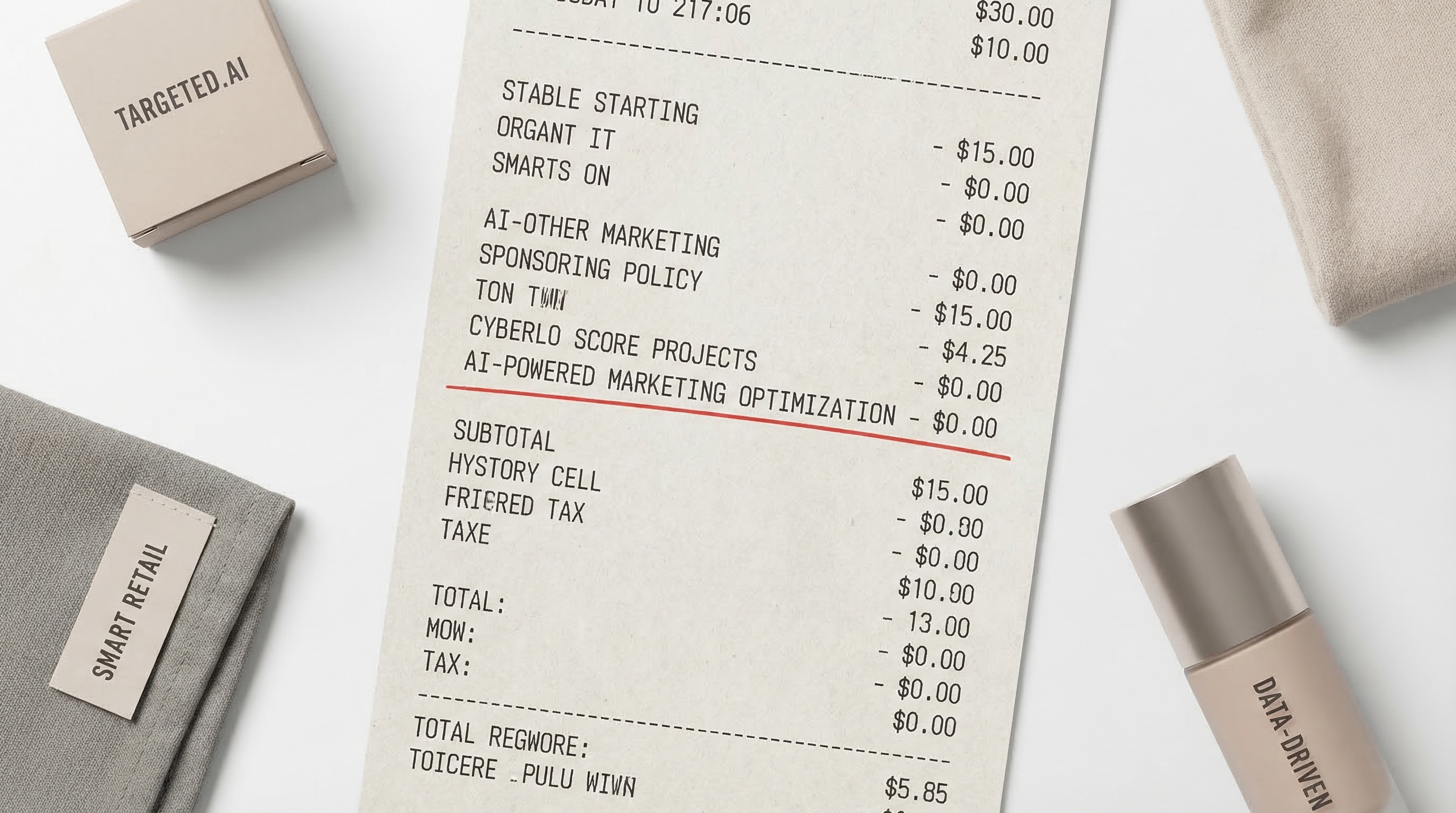
In retail, the math is unforgiving. Net margins hover between 2% and 5% for most European retailers. Every euro spent on marketing that doesn't convert is a euro the business can't afford to lose. And yet, the majority of retail marketing budgets are still allocated based on a mix of historical patterns, gut feeling, and channel-level metrics that tell an incomplete story.
The paradox is striking. Retailers sit on more customer data than any other industry. Every transaction, every loyalty card swipe, every website visit, every abandoned cart generates a data point. But most of this data either sits unused, lives in disconnected systems, or gets reduced to averages that flatten out the signal.
When your margins are this thin, the question isn't whether to invest in data-driven marketing. It's whether you can afford not to.
Because averages are easy. Average basket size, average customer lifetime value, average conversion rate by channel. These metrics are simple to compute, simple to report, and simple to use for planning. The problem is they hide more than they reveal.
An average basket size of €47 might mean that half your customers spend €20 and the other half spend €75, with completely different purchase motivations, price sensitivities, and response patterns. Marketing to "the average customer" means marketing effectively to nobody.
The same applies to channel performance. If your email campaigns show a 3.2% average conversion rate, that number blends the customers who convert every time they receive an email with the customers who haven't opened one in six months. Optimizing for the average means over-investing in contacts who would have bought anyway and under-investing in the ones who actually need persuasion.
Averages are comfortable because they simplify decisions. But in a 3% margin business, the difference between targeting precisely and targeting broadly is the difference between profitability and loss.
Three things, each with direct P&L impact.
It reduces waste in acquisition spend. Most retailers allocate acquisition budgets by channel: X% to paid search, Y% to social, Z% to display. The split is typically based on last year's performance or industry benchmarks. Data-driven attribution reveals that the actual customer journey crosses multiple channels in sequences that vary by segment. A customer who sees a display ad, searches the brand two days later, and converts through email gets attributed entirely to email in a last-click model. The display ad that initiated the journey gets zero credit, and the budget decision that follows is based on fiction.
Multi-touch attribution models, when built on clean data, redistribute budget toward the touchpoints that actually drive incremental conversions. For a retailer spending €500,000 annually on digital acquisition, a 15% improvement in allocation efficiency represents €75,000 in recovered value. On a 3% margin, that's equivalent to generating €2.5 million in additional revenue.
It increases retention ROI. Acquiring a new customer costs 5 to 7 times more than retaining an existing one. Everyone knows this. Far fewer retailers act on it with precision. Data analysis identifies which customers are drifting, what triggered the drift, and what intervention is most likely to bring them back. Not a generic "we miss you" email. A specific offer based on the category they stopped buying, sent at the time they're most likely to engage, through the channel they prefer.
The difference between a 1% and a 3% reactivation rate on a segment of 50,000 lapsed customers, with an average lifetime value of €400, is €400,000 in recovered revenue. That's not theoretical. It's what happens when you replace batch-and-blast with behavioral targeting.
It optimizes promotional depth. Promotions are the largest controllable cost in retail marketing. And most promotions are set too deep. A blanket 20% discount applied across the board gives 20% off to customers who would have bought at 10% off, or even at full price. Every unnecessary percentage point of discount on a product with 30% gross margin is money straight off the bottom line.
AI-based price optimization identifies the minimum incentive needed to trigger a purchase for each customer-product combination. Some customers need no discount at all, just a reminder. Others need 10%. Very few actually need 20%. The savings from right-sizing promotions across a full customer base compound quickly. We've seen retailers recover 2 to 4 margin points on promoted categories simply by moving from uniform to personalized discount depth.
Less than they think, but in better shape than they have it.
Transaction history with customer identification. This is the foundation. Every purchase linked to a customer ID, with product-level detail, timestamp, and store or channel identifier. Most retailers with a loyalty program have this. The question is whether it's accessible in a format that supports analysis, or buried in a legacy POS system with nightly batch exports.
Digital behavior data. Website visits, product page views, search queries, cart events, email interactions. This data exists in analytics platforms, email tools, and e-commerce backends. The challenge is stitching it together with transactional data at the individual customer level. Without identity resolution (connecting the anonymous website visitor to the known loyalty member), half the behavioral signal is lost.
Promotional history. What promotions ran, when, at what depth, on which products, targeting which customers. This data is often scattered across merchandising tools, campaign management platforms, and spreadsheets. Without it, measuring the true incrementality of a promotion is impossible.
Cost data. Product costs, marketing spend by channel and campaign, logistics costs. Without cost data integrated into the analysis, revenue-based optimization can increase top-line while silently eroding margin. The goal isn't to maximize revenue. It's to maximize profitable revenue.
The pattern is consistent: the data exists, but in silos. The first step isn't building models. It's building pipes.
Three reasons, all preventable.
The scope is too broad. "Build a 360-degree customer view" sounds strategic. It's also a project that takes 18 months and delivers an impressive dashboard that nobody uses for actual decisions. Starting with a specific business question ("which customers are we losing and why?") and working backward to the data needed is faster, cheaper, and produces measurable results within weeks rather than years.
The technical and business teams don't speak the same language. The data team builds a churn prediction model with 87% accuracy. The marketing team asks "so which customers should I email?" The gap between a statistical model and an operational action is where most projects die. Bridging this gap requires someone who understands both the model's output and the marketer's workflow. That person is rarely on the team unless you plan for it explicitly.
The infrastructure can't support the use case. A real-time personalization engine is pointless if the email platform can only send batch campaigns once a day. A dynamic pricing model is useless if the POS system requires 48 hours to update prices. The AI capability needs to match the operational capability. If it doesn't, the project delivers a beautiful prototype that lives in a Jupyter notebook and never touches a customer.
With the use case that pays for everything else.
For most retailers, that's promotional optimization. It requires data you probably already have (transaction history, promotional calendar, cost data), it produces measurable results within one promotional cycle, and the ROI directly hits the margin line. Every point of unnecessary discount recovered is pure margin.
Second priority: churn prediction and targeted retention. The math is simple. Preventing 2,000 customers from lapsing, each worth €300 in annual spend, generates €600,000 in preserved revenue. The data infrastructure built for this use case (unified customer view, behavioral event tracking) is the same infrastructure every subsequent AI initiative will need.
Third: acquisition budget reallocation. This requires more sophisticated data integration (cross-channel attribution) and typically takes longer to implement. But for retailers spending significant budgets on digital acquisition, the efficiency gains are substantial and recurring.
The key principle: each use case should fund the next one. Promotional optimization funds the data infrastructure. The data infrastructure enables churn prediction. Churn prediction validates the customer data platform. The customer data platform enables personalized acquisition. Each step produces standalone ROI while building toward a larger capability.
A European retailer with €50 million in annual revenue and a 3% net margin earns €1.5 million in profit. A 10% improvement in marketing efficiency across acquisition, retention, and promotion doesn't require AI magic. It requires clean data, focused analysis, and the discipline to act on what the numbers show.
That 10% translates to hundreds of thousands of euros in recovered margin. In a business where every point counts, that's the difference between investing in growth and managing decline.
At DNA Solutions, we build the data infrastructure and analytical capabilities that make this possible for European retailers. Not generic dashboards. Not theoretical models. The actual data plumbing, integration work, and first use cases that turn customer data into margin.
Because in retail, the companies that understand their data best don't spend more on marketing. They spend better.